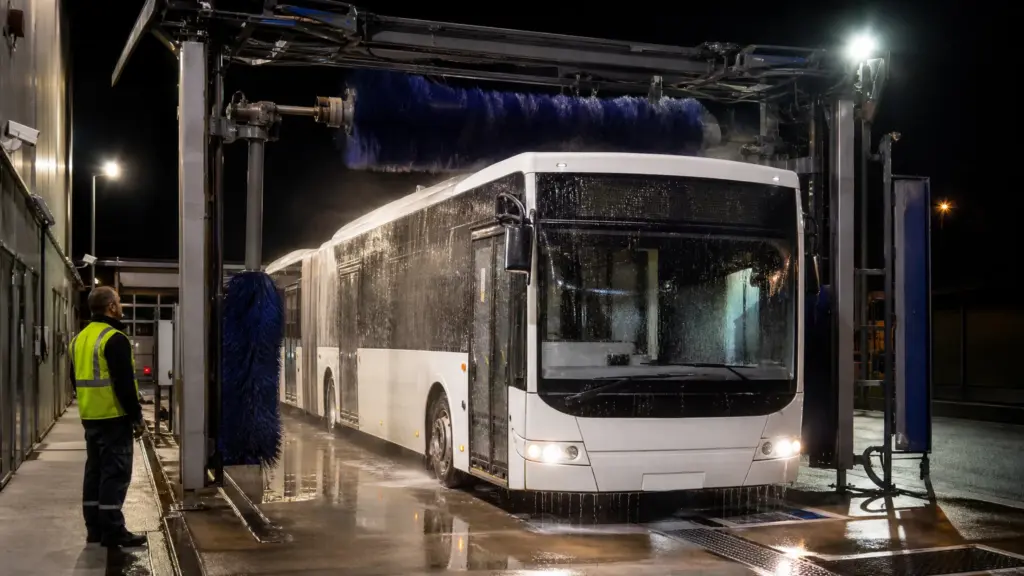
Transit bus washing works best when the wash is a station inside the nightly pull-in sequence, so each bus is touched once on its way from the road to the parking row. That means the wash sits on the same path as fueling, fluid checks and defect inspection, with enough queue room that a slow cycle does not back buses onto the street. No standard we could find prescribes the order of fuel, inspect and wash, so the order is a decision for your garage, your fleet and your shift pattern.
This article covers where the wash belongs in the service line, which wash types transit agencies use, how to think about cycle time against pull-in volume, and what to check on wastewater and safety. It is written for a transit agency wash project, whether you run a city bus wash on an existing lane or plan one for a new garage.
What the pull-in sequence is
Transit Cooperative Research Program Synthesis 12, a Transportation Research Board report sponsored by the Federal Transit Administration, defines the service line as the area of the maintenance facility where buses are fueled, inspected for mechanical defects and cleaned before returning to service. The report says most agencies include refueling, fluid checks, farebox vaulting and defect identification in the daily service line, and that virtually every agency fuels its active fleet daily.
Two cautions on that source. The report cites communications from December 1994, so it describes mid-1990s practice, and we could not confirm its exact publication date or whether a later edition replaces it. Read it as historical practice, not current data. It also does not mandate a sequence. It tells you what a service line contains, not what order the tasks must follow.
The useful point for a depot engineer is the structure. Every bus that returns at night passes one corridor. Anything that sits inside that corridor gets done daily with little extra handling. Anything outside it needs a separate move, a separate driver and a separate schedule. A nightly wash belongs inside the corridor for the same reason fueling does.
Where the wash sits relative to fuel and inspection
There are three common arrangements. Each has trade-offs, and the right one depends on your lane geometry, your staffing and how your inspectors work. The table sets them out as engineering considerations, not as a required practice.
| Arrangement | What it does well | What to watch |
|---|---|---|
| Wash first, then fuel and inspect | Inspectors see a clean body and underbody, so leaks, cracks and damage show more clearly. | Wet floors and wet buses at the fuel island. Water carried onto fueling and inspection lanes needs drainage. The wash becomes the first bottleneck on pull-in. |
| Fuel and inspect first, then wash | Fuel and defect checks are done while the bus is still warm and the operator is present. The wash is the last step before parking. | Inspectors work on dirty buses. Defects written up after the wash may mean a second pass through the bay. |
| Wash on a separate lane, scheduled by block | Fuel and inspection flow is not held up by the wash cycle. Useful for mixed fleets with different wash needs. | Extra yard movements. A bus can miss the wash if the lane is not tracked. |
If your agency runs a daily service line with fuel, fluids and farebox vaulting, the question is which of those stations is slowest. Put the wash where its queue cannot block the slowest station. In most garages that means giving the wash its own stacking lane or placing it last, so the queue forms on a lane that can hold it.
Items to settle before you choose a position
- Who drives the bus through: the operator, a service worker or a dedicated utility driver. At Ben Franklin Transit, the TCRP report notes, the operator drives the bus through the exterior washer.
- Whether defect write-ups happen before or after the wash, and who signs off.
- Whether the bay is on the route to the parking rows, so a bus never reverses against the flow.
- Where water goes when a bus leaves the bay still dripping.
- What happens when the wash is down: a bypass lane and a rule for how long buses may run unwashed.
Wash types used in transit
TCRP Synthesis 12 reports that the automated brush washer was the most common exterior washer in bus transit at the time of the survey, with buses driven through at slow speed. That is a historical finding, but the drive-through brush wash is still a familiar layout at transit garages.
The same report records that Houston Metro tried several high-pressure bus washing systems and abandoned the concept. It does not give reasons in the material we reviewed, so draw no conclusion about high-pressure water in general. It does show that agencies test and sometimes reject a wash approach after trying it on their own fleet.
Current procurement documents show agencies specifying combinations. SouthWest Transit in Minnesota issued request for bids RFB 26-0002 for a fully automatic, touchless and friction combination heavy-duty vehicle wash system, furnished, installed and commissioned. We use it only as an example of how an agency words that requirement. We did not retrieve its detailed technical attachment, so it gives no figures here.
Crawford Area Transportation Authority in Meadville, Pennsylvania, is described in a BUSRide article about a four-brush drive-through wash with a water recycling system. That article is trade press about another maker’s equipment and is undated in the copy we reviewed. It is a useful picture of what a small agency installs, and nothing in it applies to Europe Makine equipment.
Drive-through versus rollover
A drive-through wash moves the bus past fixed brushes or nozzles. A rollover wash holds the bus still while a gantry travels along it. For a city bus wash the choice usually comes down to bay length, how the driver is expected to position the bus, and whether you want a stopped vehicle during the cycle.
- Drive-through: the bus moves, so the driver controls speed and alignment. It needs a long straight run and a driver trained for the bay.
- Rollover gantry: the bus stops at a marked position and the machine moves. It suits a shorter footprint but adds a hold time with the vehicle parked in the bay.
Neither layout is better in general. Pick the one that fits your lane, your drivers and your queue length.
How often to wash
Nightly washing is a policy choice. We found no current APTA or FTA standard on nightly wash frequency, wash chemistry or wash sequence. Agencies set their own interval.
TCRP Synthesis 12 includes an example of a different interval. Santa Monica moved from a daily wash policy to a Monday, Wednesday and Friday schedule during a water shortage, and the report says this reduced labor, water, soap and equipment use. It is one agency’s response to one shortage. It shows that the interval is adjustable and that a wash line should be able to run on a reduced schedule without disrupting the pull-in flow.
When you review your own interval, look at weather, route type, the livery on the bus, and what your riders and operators see on the street. Record the decision so it can be revisited.
Sizing the wash against pull-in volume
Sizing begins with the pull-in window and the number of buses that must be washed in it. Divide the window by the cycle time to get a ceiling, then reduce it for the time each bus needs to enter, stop, leave and for the next bus to position. That second part is where most undersized washes fail.
Europe Makine publishes a washing time per vehicle for the SUNRISE W4000 of 5 to 6 minutes on its truck and bus wash systems page. For the W4700 the same page lists "7 / 14" minutes and does not explain the two values. Europe Makine does not publish a throughput in buses per hour for the SUNRISE, and the cycle time excludes the positioning time between buses. Do not divide 60 by the cycle time and call it hourly capacity. Ask for the cycle time with your own bus types and program, and add your own positioning time from a stopwatch study of your lane.
A simple sizing worksheet:
- Count the buses that return in your busiest pull-in window, including those arriving late.
- Record the length of that window, from first arrival to the last bus that must be parked.
- Take the manufacturer’s cycle time for your bus type and wash program.
- Measure the time from one bus leaving the bay to the next bus ready to wash on your lane.
- Add the two times, multiply by the bus count, and compare to the window.
- Add a margin for the wash being slower on the nights you most need it, such as winter or after a storm.
If the result exceeds the window, either add a second bay, move part of the fleet to a different interval, or take the wash out of the critical path by washing some blocks on a separate lane.
Queue room
A bus that cannot enter the bay waits somewhere. Draw the stacking lane at the length of your longest bus, plus a gap, times the number of buses you expect to be waiting at the peak. Check that a stopped queue does not block the fuel lane or the exit from the yard. Articulated buses and coaches need turning room that a 40 ft bus does not.
The SUNRISE as a rollover wash for buses
The machine on this site is Europe Makine’s SUNRISE truck and bus wash. Europe Makine describes the SUNRISE W4000 and W4700 as heavy-vehicle rollover wash systems for buses, vans and trucks. The machine travels on fixed vehicle rails as a moving gantry, with chassis-spray nozzles, PLC control with automatic programs per vehicle type, and a manual-control option.
The figures below come from Europe Makine’s product and category pages. Metric values are as published, and the US equivalents are our approximate conversions.
| Item | W4000 | W4700 |
|---|---|---|
| Maximum washing height | 420 cm (about 13.8 ft) | 470 cm (about 15.4 ft) |
| Maximum washing width | 285 cm (about 9.35 ft) | 285 cm (about 9.35 ft) |
| Washing time per vehicle | 5 to 6 min | "7 / 14" min, not explained on the page |
| Water pressure | 3.5 to 4 bar (about 51 to 58 psi) | 3.5 to 4 bar (about 51 to 58 psi) |
| Water requirement | 70 to 80 L/min (about 18.5 to 21 gpm), or 250 L/min (about 66 gpm) with optional equipment | |
| Electricity per vehicle | 0.12 to 0.15 kWh | |
| Shampoo per vehicle | 10 to 20 g (about 0.35 to 0.7 oz) | |
| Brush units | 2 vertical and 1 horizontal | |
The two Europe Makine pages are not consistent on every point. The product page lists some W4700 details as not published, while the category page gives them, so this table uses the category page. Confirm any figure you plan to specify against a current quotation.
Other features published for the machine:
- A 24 VDC traffic-light LED at the bay shows red when the machine is running or off and green when it is ready to wash. For a pull-in lane, that signal tells the driver when to enter.
- An automatic push-button winter evacuation system triggers below +4 degrees C (about 39 degrees F), which matters for water left in lines at a northern depot.
- An optional Hydrowash is brushless and uses high-pressure water robots. The category page positions it for liveried vehicles. This follows the history above: if your fleet carries wrapped or painted livery, you may want a brushless option, but test it against your own buses first.
On electrical supply, the page lists 380 V and 50 Hz. We found no US-specific electrical specification for the SUNRISE, so confirm the supply requirements for a US depot with Europe Makine and your electrical engineer before you design the power feed.
We found no manufacturer guidance on washing battery electric buses, so this article makes no claim on that. If your fleet includes them, get the bus manufacturer’s wash instructions in writing and check them against any wash program you plan to use.
Water, detergent and wastewater
The EPA stormwater best-practice sheet Vehicle Maintenance and Washing says vehicle maintenance facilities are stormwater hot spots. It adds that facilities often recycle their wash water or must treat it before release to the sanitary sewer, and it recommends biodegradable, phosphate-free, water-based detergents and limiting detergent use. The sheet is aimed at municipal public education, so we cite it only for these general points. It is not a permit.
Orange County, California, publishes fact sheet IC20 on vehicle and equipment washing and steam cleaning. It recommends a designated impervious area used only for washing and clearly marked, and covering the area if it is outdoors. It also refers to a separate fact sheet for sanitary sewer disposal. We could not confirm its date, and it is local guidance.
Discharge rules vary by jurisdiction. We found no federal or state rule we can quote for transit wash water. Before you design the drain, ask these questions of your local sewer authority and stormwater regulator, and put the answers in writing:
- Whether wash water may go to the sanitary sewer, and under what pretreatment or permit.
- Whether an oil and grit separator or a sand trap is required ahead of the discharge point.
- Whether recycling is allowed, encouraged or required, and what the blowdown or sludge handling rules are.
- Whether the bay must be roofed or bermed to keep rainwater out of the wash drain.
Your engineer or attorney makes the compliance ruling. This article cannot.
Reclaim and recycle
Reclaim systems are common in transit garages. TCRP Synthesis 12 notes that NJ Transit’s Hilton Garage has a closed water reclamation system. The BUSRide article on the Crawford Area Transportation Authority wash states that the Westmatic recycling system uses cyclonic separation to reach 10-micron water quality and reclaims up to 85 percent. Those figures belong to that maker’s system as described in trade press. They are not SUNRISE figures and they are not a general benchmark.
For a SUNRISE project, the published water requirement is 70 to 80 L/min, or 250 L/min with optional equipment. Ask Europe Makine what reclaim and treatment arrangement it proposes for your site and what the make-up water demand is with that arrangement in place. That answer sets your sewer and supply connections.
Chemistry in the nightly cycle
We did not retrieve any chemical supplier data sheet, so we make no chemical-specific claim. The practical points are general.
- Match the detergent to the water handling. A chemical that suits a sewer discharge may not suit a reclaim loop.
- Check the safety data sheet for every product, and train staff on handling, spills and eye wash.
- Check compatibility with the bus surfaces, wraps and decals, and ask the bus manufacturer if you are unsure.
- Store and dispense chemical per the product instructions, away from the wash traffic lane.
The published SUNRISE shampoo figure is 10 to 20 g per vehicle. That is Europe Makine’s figure for that machine, and your product and dilution will come from your chemical supplier.
Safety around a nightly wash
A wash bay at shift change is busy. Wash chemicals, high-pressure water and moving gantries or brushes are hazards, and the people most exposed are often the ones doing the job for the first time.
- Train every person who drives a bus into the bay or works near it, and keep that training on record.
- Use the PPE your safety data sheets and site safety plan require, including eye protection and footwear suited to wet floors.
- Apply lockout and tagout for any maintenance or cleaning inside the machine envelope. Only trained and authorized staff should do that work.
- Keep pedestrians out of the bay while a cycle runs. Mark walkways and keep the exit route clear.
- Never bypass, jump or defeat a machine safety device, and report any fault to the technician rather than working around it.
Repairs and adjustments to safety systems belong to the manufacturer’s technicians or to trained maintenance staff following the manufacturer’s procedures. This article does not describe them.
What to put in the specification
Whatever machine you choose, the specification for a nightly wash in a pull-in sequence should cover these points. Use them to compare quotations on the same basis.
- Vehicle list: every bus type in the fleet, with length, height, width and any roof equipment, mirrors or bike racks that affect the wash envelope.
- Cycle time: stated per bus type and wash program, with what is included and excluded.
- Pull-in window: the number of buses and the time available, with your peak night marked.
- Utilities: water flow and pressure, drain size, electrical supply at your voltage and frequency, and compressed air if required.
- Water handling: discharge route, recycling, treatment and sludge handling, agreed with the local authority.
- Livery and surfaces: brush or brushless contact, and what the vehicle manufacturer allows.
- Controls and signals: bay lights, driver instructions, manual override and what happens in a fault.
- Winter operation: freeze protection and drain-down, if your depot sees freezing weather.
- Service: where technicians and spare parts are held and how quickly they reach your depot. Europe Makine holds technicians and spare parts at its base in Greenacres, Florida.
- Commissioning: acceptance test with your own buses, run through the full nightly sequence.
Price depends on the number of bays, the vehicle envelope, the water treatment, the utility work and the site civil work. Europe Makine quotes after it has seen the site and the vehicles.
Putting it together
A nightly wash that fits the pull-in sequence has four properties. It sits on the path buses already take. Its queue has a lane of its own. Its water has a lawful place to go. Its operators are trained and its safety systems are left intact. Everything else, including the choice between a drive-through and a rollover machine, follows from those four.
Start with your own numbers: buses per night, the pull-in window, the bus types and the drain you have. For more on equipment families, see Europe Makine’s page on truck and bus wash systems.
Talk to Europe Makine when you have your fleet list, pull-in window and drain details ready, because a site survey is the step that turns this general information into a layout; this article does not replace one.
Questions and answers
- Where should the wash go in the nightly pull-in sequence?
- No source we found prescribes an order for fuel, inspection and wash. Place the wash on the path buses already take and give its queue a stacking lane that cannot block the fuel island or yard exit. Whether to wash before or after inspection is a decision for your garage.
- How long does a SUNRISE wash cycle take?
- Europe Makine lists 5 to 6 minutes per vehicle for the SUNRISE W4000 and "7 / 14" minutes for the W4700, without explaining the two W4700 values. The cycle time does not include positioning between buses, and no throughput in buses per hour is published, so measure your own lane.
- Does a transit agency have to wash buses every night?
- We found no current APTA or FTA standard on wash frequency. TCRP Synthesis 12 records Santa Monica moving from a daily wash to a Monday, Wednesday and Friday schedule during a water shortage. Frequency is an agency policy decision.
- Can wash water go to the sanitary sewer?
- Often it can only after treatment or recycling, according to the EPA best-practice sheet, but rules vary by jurisdiction. Ask your local sewer authority and stormwater regulator, and have your engineer or attorney confirm what applies to your site.
- Does the SUNRISE run on US electrical supply?
- Europe Makine's page lists 380 V and 50 Hz. We found no US-specific electrical specification, so confirm the supply requirements for a US depot with Europe Makine and your electrical engineer before design.